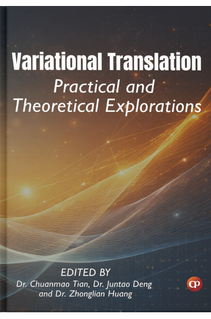
Description
Variational Translation Theory (VTT), first formulated by Professor Huang Zhonglian in 1999, has incorporated both Chinese and foreign thought, especially the philosophy of change embodied in the ancient Chinese classic Book of Changes, and it sees change as a striking, gradual process. Compared with the change a text undergoes in complete translation, a change or “variation” in variational translation (VT) may be viewed as a kind of fast, thorough, and global changes, including instant, immediate, and substantial changes. VTT can help translators do their job more quickly and accurately with higher efficiency and better quality. Therefore, VT can be defined as an intelligent and intersemiotic activity in which a person or/and a machine uses one language to develop flexibly the cultural information in another language so as to meet the specific needs of specific readers under specific conditions (Huang, 2002: 97).
Bibliographic details: The bibliographic details of the book are available at https://dx.doi.org/10.46679/9789349926769